The tax bill on a piece of Monroe County timberland can look almost too good to be true. Somebody selling forty acres of loblolly pine near Peterman might tell you their yearly county tax runs a few hundred dollars, and they're not exaggerating. Monroe County's median property tax bill sits at just $244 a year, one of the lowest figures anywhere in Alabama.
What that seller usually doesn't mention, because most sellers genuinely don't think about it, is that the number belongs to them, not to the land itself. It does not travel with the deed. If you buy that same tract and never file a piece of paper with the county, your bill can jump to full market-value assessment the very next tax year, and nobody at the closing table is required to warn you.
The Number Everyone Sees Isn't the Number That Follows You
Alabama has taxed farmland and forest differently from everything else since 1978. Under a system the state calls current use valuation, land that's actively growing timber, running cattle, or producing crops gets assessed on what it earns as farmland or forest, not on what a developer might pay for it. The state recalculates this figure every year using Farm Credit Bank capitalization rates and USDA production costs. This year's published range runs from roughly $360 to $827 per acre depending on soil and timber productivity, a fraction of what raw acreage near a highway or a growing town might otherwise fetch on the open market.
Alabama then taxes that already-discounted value at just 10 percent, the same low rate applied to owner-occupied homes. Compare that to how the rest of the tax code treats property:
| Class | What it covers | Assessed at |
|---|---|---|
| Class I | Utility company property | 30% of market value |
| Class II | Commercial and business property | 20% of market value |
| Class III | Farmland, forest land, owner-occupied homes, historic buildings | 10% of market value (or current use value, if approved) |
| Class IV | Personal vehicles | 15% of market value |
Agricultural and forest land sits in the same favored class as a family's own house. That's by design. The 1978 law and its 1982 amendment were built so a farmer wouldn't get taxed on the speculative value of land that might someday become a subdivision. The tradeoff is that the discount is tied to the current owner's approved application, not to the parcel of dirt.
Why the Break Doesn't Ride Along With the Sale
Here's the part that catches buyers off guard. Current use is not automatic and it is not permanent once a deed changes hands. County revenue offices across the state, including the ones handling Mobile and Montgomery counties, are explicit about this: when ownership transfers, the new owner has to file their own current use application, generally in the window running from October 1 through the following January 1. Miss that window and the county is free to assess the parcel at fair market value until the paperwork catches up, sometimes for an entire tax year.
For someone buying forty acres near Uriah or Beatrice planning to keep it in pine, this is a matter of filing a form on time. For an heir who lives in Birmingham or Atlanta and inherits a piece of family timberland outside Frisco City, it's easy to miss entirely. Nearly 60 percent of Alabama's timberland is owned by people who live outside the county where the land sits, which means the person legally responsible for reapplying is often the person least likely to know the deadline exists.
The Rollback That Waits Behind the Trees
The second trap is bigger. If land that's been valued at current use gets converted to something that no longer qualifies, cleared for a subdivision, built out for commercial use, taken out of active timber or crop production, the county can claw back the difference. Alabama law calls this a rollback, and it works two ways. If a sale is followed by a disqualifying conversion within two years, the rollback applies. If the conversion happens at any point after that, even years later, it still applies. Either way, the assessing official recalculates what the taxes would have been at fair market value, not current use value, going back over the prior tax years, and bills the owner of record on October 1 following the conversion for the difference.
That last detail matters more than it sounds like it should. The person who owed the rollback tax isn't necessarily the person who caused the conversion. If land changes hands between the conversion and the following October 1 lien date, the new owner can inherit a tax bill created by someone else's decision to clear the land, build on it, or sell off part of it for development. Buying a tract that's been in current use for decades without asking directly what the seller's plans were, or what happened to the acreage right before the sale, means buying blind on this specific point.
Alabama also puts no ceiling on how much acreage can carry the current use discount. Georgia caps it around 2,000 acres to keep the benefit aimed at family farms. Alabama doesn't, so a large corporate timber holding gets the exact same 10 percent treatment as a hundred-acre family tract. That's a policy debate for someone else's column. What it means for a Monroe County buyer is that current use land isn't a rare, small-parcel exception. It's the baseline condition of most working land in the county, which is exactly why the reapplication requirement trips up so many people who assume the tax bill they saw in the listing is simply how the county taxes that address.
What This Looks Like on Working Ground
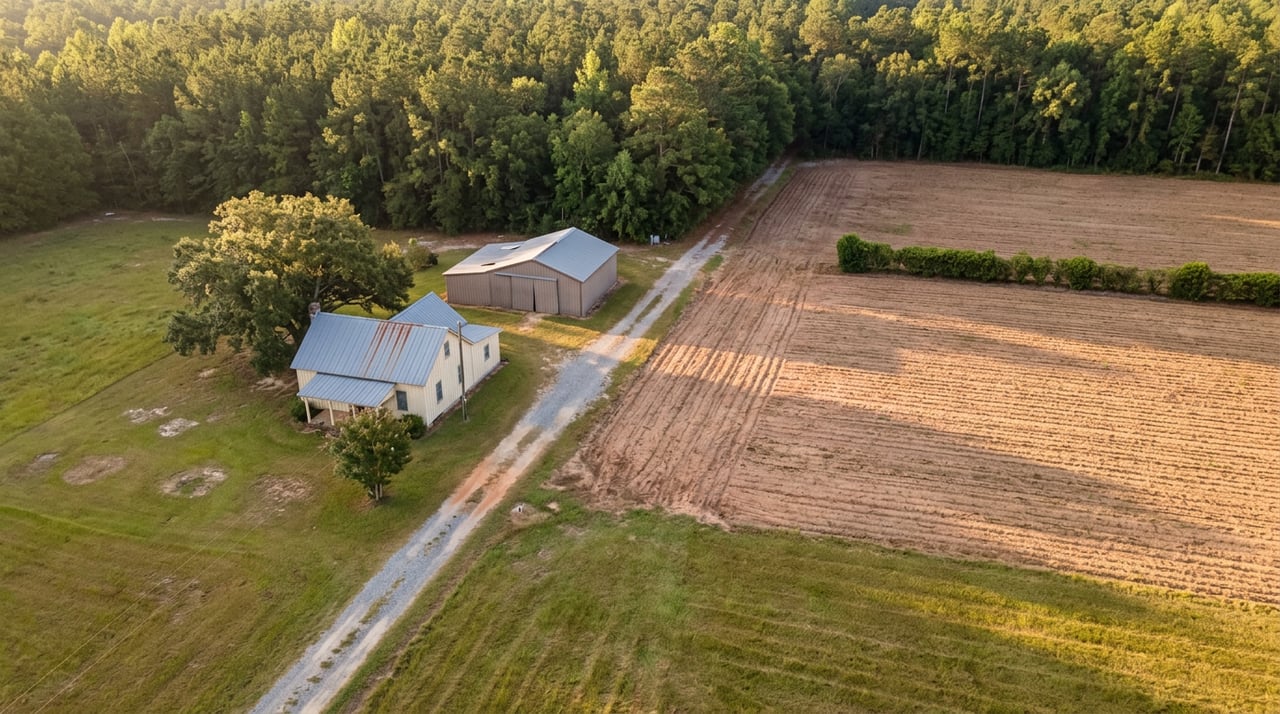
Monroe County's land market is built almost entirely around this kind of property. Listings run the range from managed loblolly and longleaf pine plantations to row-crop ground along the Alabama River basin near communities like Burnt Corn, Goodway, and Tunnel Springs, with hunting tracts, creek-bottom hardwoods, and a handful of poultry operations mixed in. Current listings as of September 2026 put average acreage prices in the range of roughly $8,400 an acre, though pricing swings hard depending on whether the land is merchantable timber, recently clear-cut and regenerating, or open crop ground with irrigation potential. A tract that's been thinned and replanted in the last few years prices very differently from one carrying 25-year-old pine ready for harvest, and the current use value the county assigns doesn't move with either of those market realities. That gap, between what the land is worth on the open market and what it's taxed on, is the entire point of the program and the entire reason the paperwork matters so much at the moment of sale.
Before You Sign Anything
A few questions are worth asking before closing on Monroe County acreage, whether you're the one selling family land or the one buying it:
- Ask whether the seller currently holds a current use designation, and for how long it's been in place.
- Ask what, if anything, happened to the land's use in the two years before the sale. A recent clear-cut, a partial conversion, or a change in active use can set up a rollback that lands on the next owner.
- Mark your calendar to file your own current use application with the Monroe County Revenue Commissioner's office, currently run by Elizabeth House Saucer out of Monroeville, promptly after closing rather than assuming the benefit carries over.
- If you're planning to build a home, subdivide, or otherwise change how the land is used, understand that the rollback calculation reaches back three tax years and gets billed to whoever owns the property on the following October 1.
- If you're inheriting rather than buying, treat the reapplication requirement the same way. A change in ownership by will still triggers the need to refile.
None of this is tax advice, and every county assessing official has some discretion in how they apply these rules, so a conversation with the Monroe County Revenue Commissioner's office before closing is worth more than any general guide, including this one.
A Few Quick Questions
Does current use carry over if I inherit land instead of buying it? No. A change in ownership by deed or by will still requires the new owner to file their own application with the county.
What actually counts as a disqualifying conversion? Generally, taking the land out of active agricultural or forest use and putting it toward something else, residential development, commercial use, or simply letting it sit unused past what the county considers qualifying activity.
Does harvesting timber trigger a rollback? Harvesting itself isn't the trigger. The land staying in forest production, even after a cut, generally keeps its current use status. The trigger is converting the land to a different use entirely.
If I only develop part of a larger tract, does the whole parcel lose current use? The county typically evaluates use on the actual acreage converted, but the details depend on how the parcel is platted and assessed, which is another reason to talk to the revenue commissioner's office before you start clearing ground.
If you're weighing a piece of Monroe County land, whether it's forty acres you're inheriting from family or a few hundred acres of pine you're sizing up as an investment, the team at PHD Realty has spent years walking clients through exactly this kind of paperwork, alongside the boundary questions, access issues, and local knowledge that come with rural Alabama acreage. Reach out before you sign anything. It costs nothing to ask, and it can save a lot more than $244 a year.